remove.bg, the default background removal API for most of a decade, closes its standalone service on 1 December 2026 and moves its API to a different service the same day. If you integrate background removal in 2026 you are choosing a replacement, not a default. This comparison looks at what matters when the output goes straight into a product: cut-out quality, input and output formats, resolution and file limits, rate limits, SDKs, and what each provider charges. For free tiers and cost-only comparisons see free background removal APIs compared.
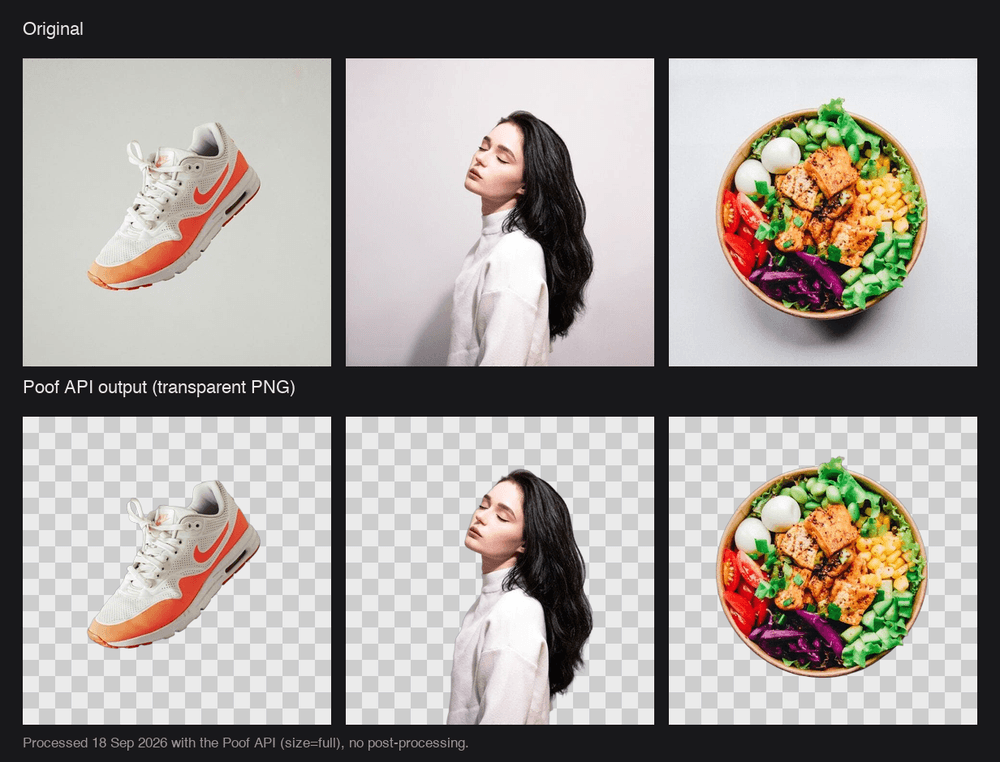
Poof output on a sneaker, a portrait and a food bowl, processed on 18 September 2026 with size=full and no post-processing. We only show our own output here; run your own images through the free image background remover and through any competitor before you decide.
Comparison table
| API | Input / output | Limits | Rate limit | Entry price per image | Best for |
|---|---|---|---|---|---|
| Poof | PNG, JPG, WEBP, still GIF in; transparent PNG, JPG, WebP or alpha mask out | 20 MB, 36 MP (≈6K) | 4–200 req/min by plan | $0.0045 (Pro); from $0.002 on volume plans | Drop-in remove.bg replacement at a fraction of the price |
| remove.bg (closing 1 Dec 2026) | PNG, JPG, ZIP (colour + alpha) | 12 MB; 25 MP via ZIP/JPG, 10 MP via PNG | Up to 500/min, resolution-dependent | €9 / 40 credits (€0.225) on the smallest plan | Existing integrations until 1 Dec 2026 |
| Photoroom | Image in; cut-out or fully edited image out | Not published | Not published | $0.02 (remove background); $0.10 (image editing) | Product photos that need backgrounds, shadows and templates too |
| ClipDrop (Jasper) | PNG, JPG, WEBP in; PNG out | 30 MB, 25 MP | 60 req/min | Not published (contact Jasper) | Teams already on Jasper |
| withoutBG | Image in; cut-out out | Not published | Not published | €0.10; €0.05 at volume | Small workloads, EU billing |
| Pixelcut | Image in; cut-out out | Not published | Not published | $0.05 (5 credits × $0.01) | Apps that also use its upscaler and generator |
| fal.ai (Bria RMBG 2.0) | Image in; cut-out out | Not published | Not published | $0.018 | Teams standardising on fal for other models |
| Cloudinary | Transformation on stored assets | Platform limits | Platform limits | Billed as transformations; add-on closed to new accounts since 1 Feb 2026 | Images already hosted on Cloudinary |
| Replicate (open models) | Depends on model | Depends on model | Depends on model | Per second: T4 $0.000225/s | Teams that want to operate their own pipeline |
Verified 18 September 2026 on each provider's documentation or pricing page. "Not published" means the provider does not state the figure publicly. Prices exclude tax.
Test with your own images first
The free image background remover runs the same model as the API. Upload the images that break other tools: hair, glass, fine straps, low-contrast products.
Open the free image tool →How to judge a background removal API
Every provider on this list claims high accuracy, and none publish a benchmark you can reproduce, so accuracy claims are not a useful basis for a decision. What you can check in an afternoon:
- Your images, not theirs. Demo pages use easy subjects. Send the ten images your users actually upload, including the ugly ones, to each API and compare the edges at 200%.
- Alpha quality, not just the cut-out. If you composite onto new backgrounds, ask for the raw alpha mask and look at hair, fur and semi-transparent glass. Poof exposes it directly with
channels=alpha. - Formats and size limits. Do you need WebP out? 4,000-pixel product shots? A 20 MB RAW-derived JPG? Check the ceiling before you build.
- Rate limits and burst behaviour. A catalogue import sends thousands of images in minutes. Know the per-minute limit on the plan you will actually be on, and what a 429 looks like.
- Data handling. Whether uploads are stored, for how long, and where.
- Whether the provider will exist next year. remove.bg users are learning this the hard way.
The APIs
1. Poof
Poof is a single-purpose REST API: send an image, get the cut-out back in under two seconds. It accepts PNG, JPG and WEBP up to 20 MB and 36 megapixels, and returns a transparent PNG, a JPG or WebP on a solid colour, or the alpha mask alone. Requests are simple multipart uploads, so a remove.bg integration usually needs only the endpoint and the key changed; the migration guide lists the mapping. Official Python and TypeScript SDKs, an MCP server and n8n, Zapier and Make nodes cover most stacks, and images are never used for training. Plans run from a free 100 images a month to 200,000 images for $299, with rate limits from 4 to 200 requests a minute. It is the cheapest per-image option here by a wide margin; what you give up is the editing layer that Photoroom or Pixelcut add on top.
2. remove.bg, closing on 1 December 2026
Still the reference for cut-out quality and the API most people have already integrated. Two facts now dominate any evaluation: the standalone service closes on 1 December 2026, and its API moves to a different service on the same date. The API itself is mature: ZIP output with separate colour and alpha layers, images up to 25 megapixels, and a resolution-dependent rate limit of up to 500 images a minute. If you are on it, plan the move; the credits you hold expire on 1 December.
3. Photoroom
Photoroom sells two APIs: a Remove Background API at $0.02 an image and an Image Editing API at $0.10 an image that adds AI backgrounds, shadows, padding and templates in the same call. It is the right choice if the cut-out is a step in a larger product-photo pipeline you would otherwise build yourself. For cut-outs alone it is roughly ten times Poof's volume price.
4. ClipDrop (Jasper)
ClipDrop's remove-background endpoint takes PNG, JPG or WEBP up to 25 megapixels and 30 MB, at 60 requests a minute per key, and returns a PNG. Since the acquisition by Jasper the public pricing page has been replaced by a contact form, so treat it as an enterprise conversation. The 100 free development credits are still available.
5. withoutBG
A small European provider with straightforward credit packs: €10 for 100 images, down to €0.05 an image at volume. Public documentation on limits and formats is thin, so test before committing. Reasonable for low volumes where EU invoicing matters.
6. Pixelcut
Pixelcut prices every operation in credits at $0.01 each; background removal costs 5 credits, so $0.05 an image, with upscaling, background generation and virtual try-on at 10 credits. Worth a look if you would use those other tools; expensive for cut-outs alone.
7. fal.ai running Bria RMBG 2.0
fal hosts Bria's RMBG 2.0 at $0.018 per image with the commercial licence included, which makes it the simplest way to use a strong open-weights model without running it. There is no free tier and no per-plan rate limit published; you get fal's general platform limits.
8. Cloudinary
Cloudinary's background removal is a transformation applied to assets you already store there. The dedicated add-on is being deprecated and accounts created after 1 February 2026 cannot subscribe to it; new usage is billed as transformations. Choose it only if Cloudinary is already your image pipeline.
9. Replicate and self-hosted open models
Models such as rembg, BiRefNet and RMBG can be run on Replicate (metered per second of hardware, from $0.0001 on CPU) or on your own GPUs. At very high volume this is the cheapest path, and you control the model version. You also own cold starts, scaling, licensing checks and quality regressions. Most teams below a few million images a month are better served by a managed API.
Recommendation
If you need cut-outs at production volume and want the smallest bill, use Poof. If the cut-out is one step in a generated product-photo pipeline, look at Photoroom. If you already host on Cloudinary or build on fal, stay in that ecosystem. And if you are on remove.bg, whichever you choose, move before 1 December 2026.
Need video too? Poof also removes backgrounds from video, with the same API key and the same credits as images: see the video background remover API.